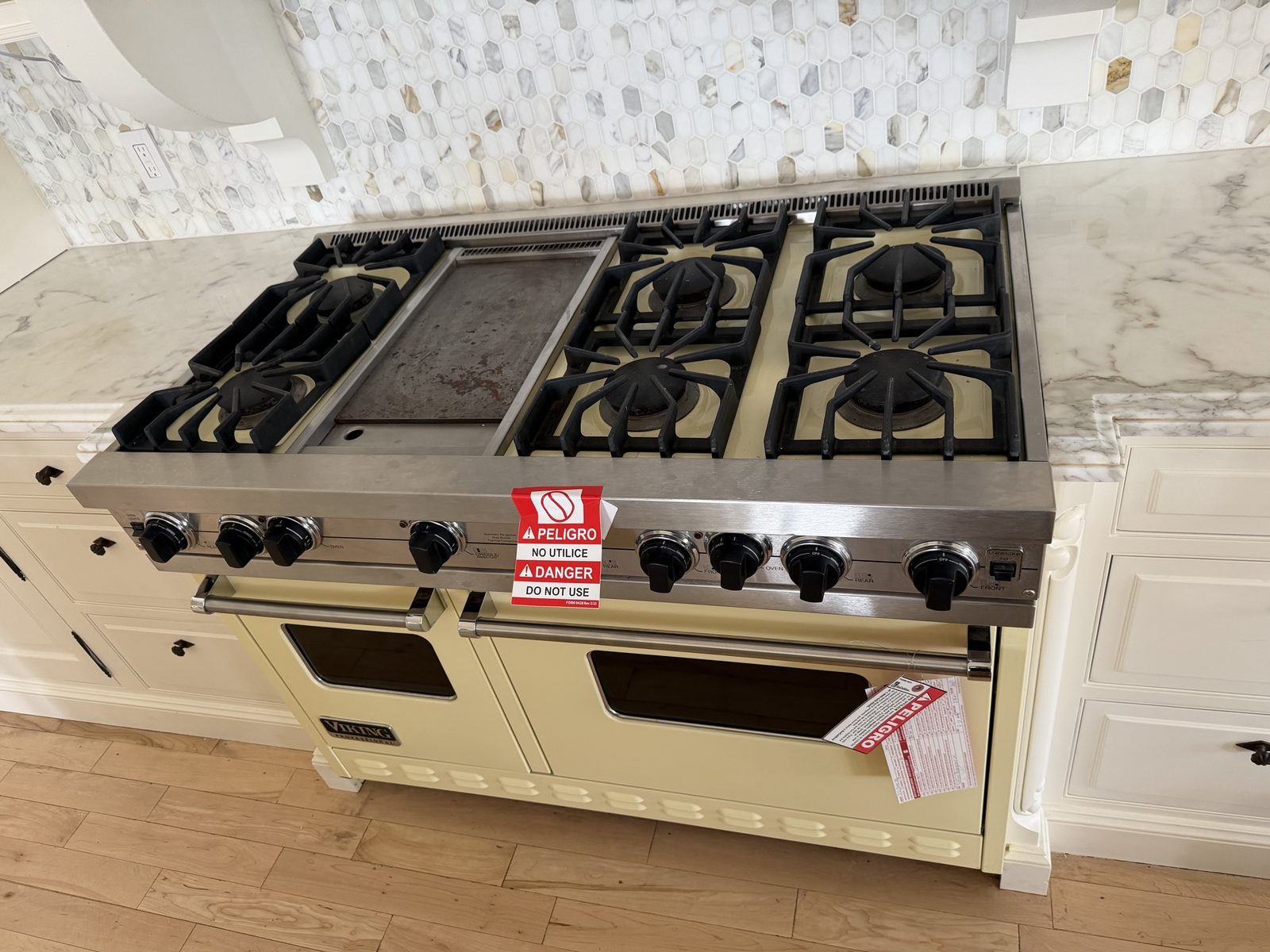
When a SoCalGas technician walks out of your kitchen with a red DANGER tag zip-tied to your Viking range and a Notice of Unsatisfactory Conditions in your hand, you understand the stakes instantly. This is the story of a Malibu homeowner who called us in April 2026 after their 48-inch Viking Professional—a six-burner, griddle, double-oven centerpiece—was shut down mid-inspection for an active gas leak.
What a Red Tag Actually Means
A red tag is not a suggestion. It's a mandatory shutdown issued by the utility when an appliance or piping presents an immediate hazard—usually an active gas leak, improper venting, or a flame-rollout condition. The tag states DO NOT USE in English and Spanish, and the technician physically shuts off gas supply to that appliance by capping the line or closing the valve.
In this case, the SoCalGas field technician detected combustible gas near the Viking's oven cavity during a routine service call. The homeowner had reported a faint gas odor when preheating; the technician confirmed it with a combustible-gas detector and applied the red tag on the spot. Once tagged, the appliance cannot legally be used until a licensed repair contractor clears the defect and SoCalGas reinspects or accepts a signed clearance affidavit.
We see these tags most often on older ranges in coastal LA and Ventura County—Malibu, Manhattan Beach, Palos Verdes—where salt air accelerates corrosion on brass fittings and flex connectors. Viking Professional ranges, built like commercial units, have robust gas trains, but any threaded joint or compression fitting can weep over time if the pipe dope degrades or a valve seat shifts.
Reproducing the Leak
When the homeowner called our (747) 207-2030 line, we scheduled same-day service. Our technician arrived with a manometer, soap-bubble solution, and the service literature for Viking's dual-fuel professional series. Step one is always independent verification—never trust that the leak is where the utility tech said it was, and never assume a single leak.
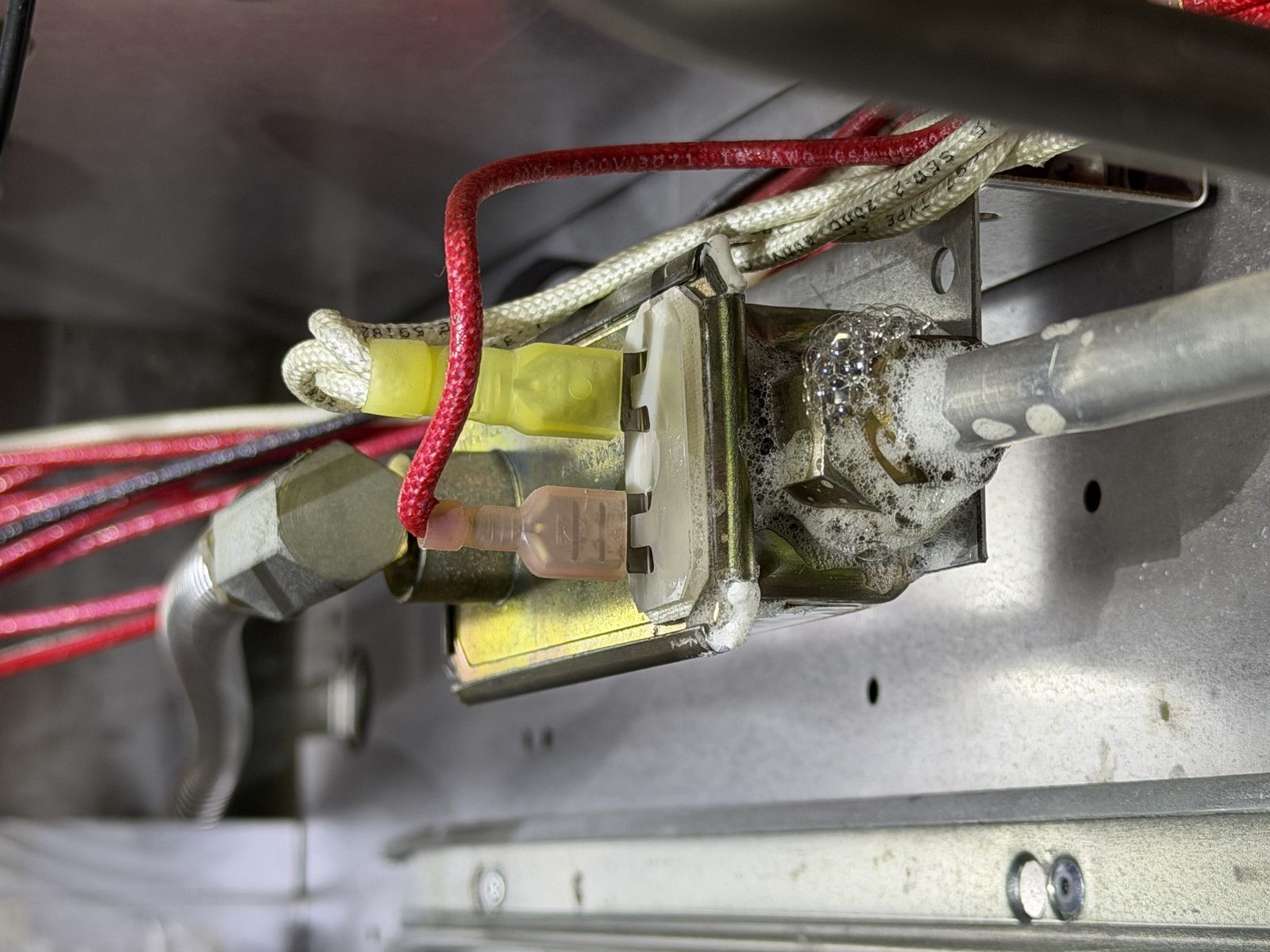
We applied a rich soap solution to every gas joint on the range: the main supply flex connector, the manifold-to-valve fittings for all six burners and the griddle, both oven safety valves, and the standing-pilot assemblies. Within fifteen seconds, bubbles began forming at the threaded connection where the oven safety valve mates to the oven burner supply tube—a slow but continuous foam that confirmed an active leak. The photo documentation we took for the homeowner's records clearly showed the bubble formation at that single joint; every other connection remained dry.
Why You Never DIY a Red-Tagged Gas Appliance
We've had calls from homeowners who removed the zip-tie, fired up the range, and hoped the problem would resolve itself. That is both illegal under California code and profoundly dangerous. Natural gas is odorless; the mercaptan odorant is added so you can smell it, but your nose fatigues quickly, and a small leak in a well-ventilated kitchen may not register until you've been breathing it for hours.
More critically, any spark—a pilot light, a wall switch, even static discharge—can ignite a gas-air mixture if concentrations reach 5 to 15 percent. A leak at an oven safety valve means gas is escaping inside the oven cavity and potentially migrating behind the range into the wall chase. If the igniter cycles or the convection fan runs, you have an ignition source and fuel in the same space.
California law requires a CSLB-licensed contractor or a manufacturer-authorized service company with BEAR licensing to repair gas appliances. A&Y holds California BEAR License #49435. We carry liability coverage for gas work, and our technicians are trained on the specific gas-train layouts of every brand we service—Viking, Thermador, Wolf, BlueStar, and thirty others. Homeowner repairs void warranties, violate code, and leave you personally liable if something ignites.
The Repair Process for a Safety-Valve Leak
Once we confirmed the leak location, the repair sequence was methodical. First, we shut off gas supply at the range's dedicated shutoff valve—the code-required quarter-turn ball valve on the flex connector behind the unit. We then pulled the range forward enough to access the rear panel and lower oven enclosure, disconnected shore power at the junction box, and removed the oven's lower access panel to expose the burner assembly and safety valve.
The safety valve itself is a thermocouple-actuated gas valve that permits flow only when the thermocouple senses flame. The leak was not in the valve body but at the threaded pipe union where the valve outlet connects to the oven burner's supply tube. We disassembled that union, inspected the threads for cross-threading or damage—there was minor thread galling and old dried pipe dope—then cleaned both male and female threads with a wire brush and solvent.
We applied fresh yellow PTFE gas-rated thread sealant to the male threads, reassembled the union hand-tight, then torqued it to spec with a flare-nut wrench—enough to compress the threads without deforming the brass. After reassembly, we restored gas supply in stages: cracked the shutoff valve to pressurize slowly, then fully opened it and let the system sit under static pressure for two minutes. We then applied soap solution to every joint we had touched, plus the original leak point, and watched for sixty seconds. Zero bubble formation.
Final step: operational verification. We cycled each oven through a preheat to 400°F, held it for ten minutes, then ran the broiler. We checked flame color—sharp blue cones, no yellow tips—and used the manometer to confirm manifold pressure stayed at 5 inches water column under load. We left the site only after the homeowner watched both ovens and all burners operate without odor or abnormal behavior.
Clearance and Re-Light
In Los Angeles County, SoCalGas allows a licensed contractor to remove a red tag and restore service if we provide a signed affidavit describing the defect and the repair. Some cities—Malibu included—require the utility to reinspect before the tag is removed. In this case, we documented the repair with photos, completed a gas-tightness affidavit on our letterhead with our BEAR license number, and the homeowner scheduled a SoCalGas follow-up inspection within 48 hours.
The utility returned, ran their own combustible-gas survey, and signed off on the clearance. Total appliance downtime: three days from red tag to full service. The $85 diagnostic fee was applied toward the labor as always, and we walked the homeowner through the new baseline—what normal smells like, what flame color to expect, and when to call us if anything changes.
If You Smell Gas: Leave First, Repair Second
If you detect a strong gas odor anywhere in your home—rotten eggs, sulfur, that distinctive mercaptan smell—do not investigate, do not flip light switches, do not start your car in an attached garage. Walk out, take your family, and call SoCalGas emergency dispatch from outside at 1-800-427-2200. They will dispatch a crew immediately at no charge; this is a life-safety emergency, not a billing event.
Once SoCalGas secures the leak or shuts off supply, then you call a licensed repair contractor. We've responded to dozens of these calls across Ventura County and LA County—Thousand Oaks, Agoura Hills, Pacific Palisades, Brentwood. A red tag is not a crisis if you handle it properly. It's a forcing function that ensures the repair happens before someone gets hurt.
Why This Matters for Luxury Appliance Owners
Malibu, Manhattan Beach, and the west-side coastal corridor have the highest density of commercial-grade residential ranges in Southern California—Viking, Wolf, BlueStar, Thermador Pro Grand. These are 20,000-to-60,000-BTU workhorses with complex gas trains, multiple regulators, and dozens of threaded fittings. They are not inherently unsafe, but they demand proper installation and periodic inspection.
We recommend a gas-tightness inspection every three years for any range older than ten years, and annually for any appliance in a coastal zone where salt air contacts fittings. A $200 leak inspection is vastly cheaper than a red tag, a multi-day shutdown, or a catastrophic event. If you're in LA County or Ventura County and your Viking, Thermador, or Wolf range is more than a decade old, call us at (747) 207-2030 to schedule a preventive pressure test. We serve all 56 cities in our territory, daily from 8am to 8pm, and same-day appointments are always available for safety concerns.